
How to Check Criminal History in McKeesport
Begin with McKeesport Police for the incident narrative. Search UJS at the magisterial district and Common Pleas levels for court events. Use Allegheny County Jail for custody, DCR for the official filed case, and PATCH for a Pennsylvania repository check.
- Identify the McKeesport Police report or incident.
- Ask the department for its current request form and release terms.
- Search UJS for the proper preliminary docket.
- Follow custody and held charges into county systems.
- Use PATCH only for the separate PSP repository response.
McKeesport Records Have Five Stops
A McKeesport event can create records at five offices. City police holds the original report. A magisterial district holds preliminary events. Allegheny County Jail tracks booking and custody. Common Pleas and DCR hold a filed prosecution. PSP maintains repository criminal history. Pittsburgh Police is not part of this chain.
Ask which fact is needed before choosing a stop. Final guilt or dismissal comes from the court disposition, not the city report.
The McKeesport Police Department
The McKeesport Police Department is the correct source for its city report. The separate 18 Pa.C.S. § 9121 source governs PSP dissemination.
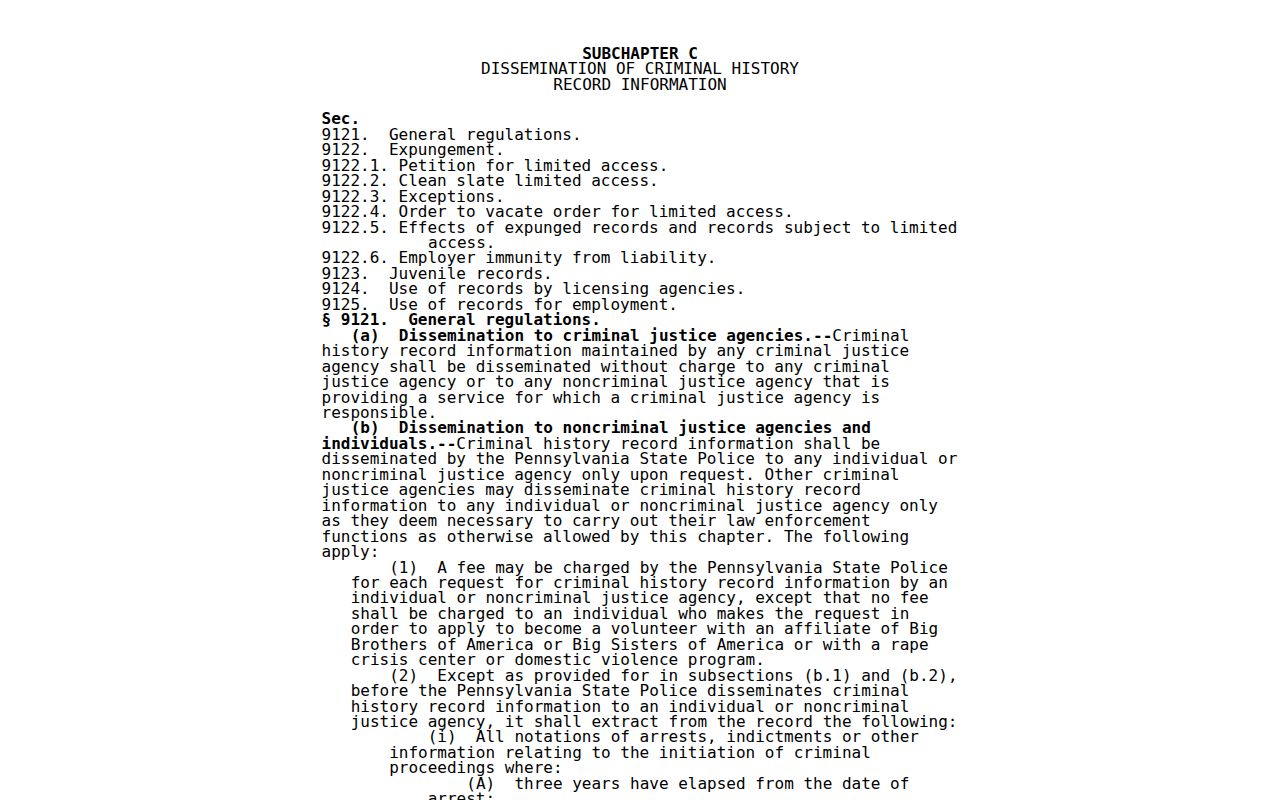
The statute image reinforces that a city report and PSP dissemination are different legal channels.
Confirm the current records address, hours, email, fee, and form on the official department page. Give a precise date range, location, record description, and incident number when known.
Request McKeesport Reports at Source
County DCR does not hold the original police narrative. Send that request to McKeesport. Investigative details, victim information, and protected identifiers may be withheld or redacted. The court docket remains a separate public-access question.
If the department cannot release a report, search UJS for the complaint, charges, schedule, and disposition. A denial at one office does not decide access at another.
Arrests and Bookings in McKeesport
Booking and current custody move into Allegheny County channels. Call the jail at 412-350-2000 when no public result appears; the person may have been released or transferred. Use the state DOC locator only after state transfer.
Intake charges may change. The prosecution docket shows what was filed and how each count ended. Arrest is not proof of guilt.
McKeesport Custody After Transfer
The county publishes continuing jail reports and custody channels.
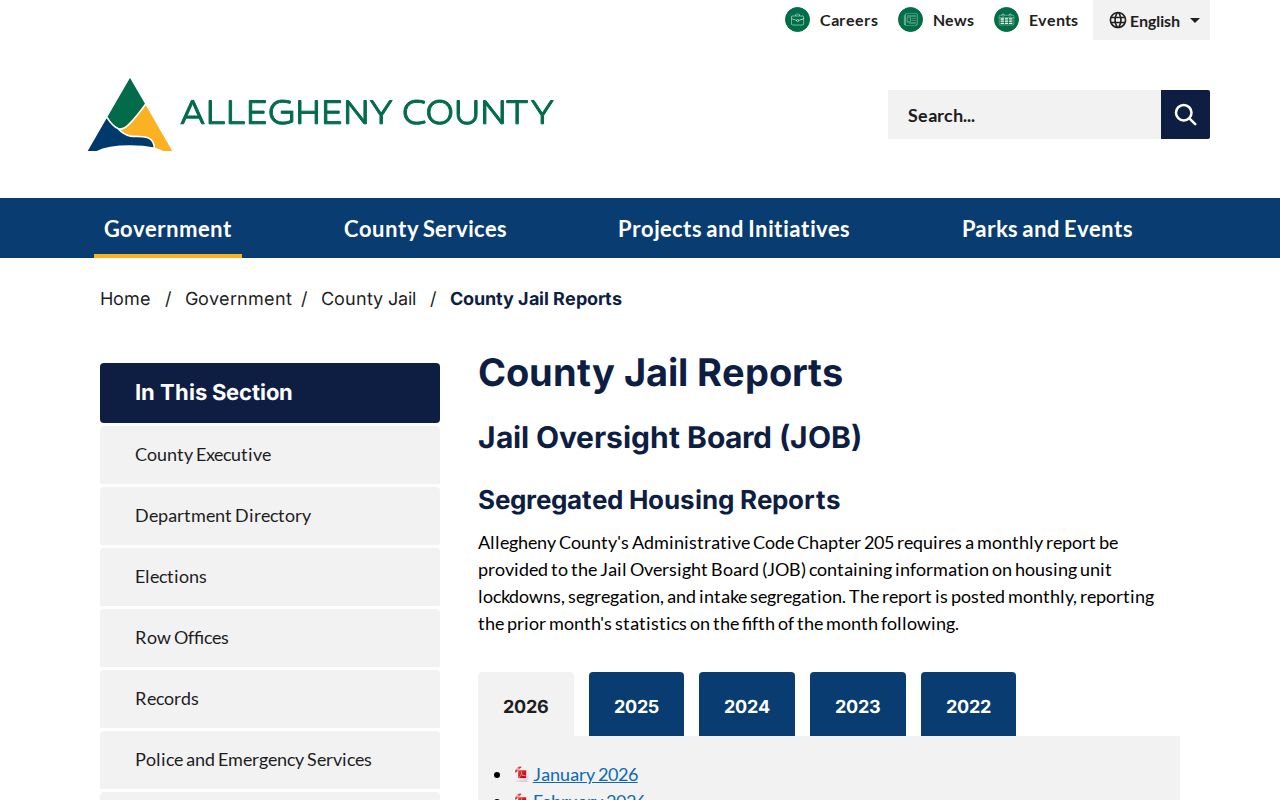
These county reports provide system context, not a city arrest gallery or proof about any person.
A December 2025 county re-entry program also illustrates what happens after city custody enters county systems.

The program belongs to the downstream county stage, not the original McKeesport police file.
McKeesport Municipal Court Records
McKeesport preliminary criminal events appear in the appropriate magisterial district. Summary matters can remain there, while charges held for court proceed to Allegheny County Common Pleas.
| Court Name | Serving Magisterial District, then Court of Common Pleas |
|---|---|
| Case Types Heard | Summary cases and preliminary criminal matters |
| Case Lookup Channel | UJS Case Search and the court clerk |
| What the Docket Shows | Charges, events, bail, counsel, outcomes, and sentence |
| Copies & Fees | Current official court schedule applies |
Where McKeesport Records End Up
McKeesport Police creates the report. The minor court handles initial judicial events, and held charges move to Common Pleas. Reportable outcomes then reach PSP.
Record flow: McKeesport PD › Allegheny County Courts › Pennsylvania State Police Central Repository
Recent facts may be split among several offices. For an older final result, use the court disposition and compare it with PSP when reviewing repository data.
McKeesport Police Report Versus UJS
The report records what police received and did. UJS records the court case. A docket can show withdrawn, dismissed, acquitted, guilty, or nolle prosequi outcomes that never appear in the first narrative. Read each charge line.
Use participant name, Allegheny County, court level, filed dates, status, and docket type to narrow results. A docket number is the safest match.
McKeesport Cases at Grant Street
Once held for court, the official file belongs with DCR at 436 Grant Street. Room 220 handles criminal records and money matters. Current and four prior years stay on site; older files require retrieval.
A web docket is not a certified judgment. Request the file and certification when formal proof is required.
McKeesport OTN and Docket Keys
The OTN connects fingerprint processing with the prosecution. A Common Pleas docket often uses CP-02-CR-sequence-year. These keys help separate people with the same name and connect city, court, and repository records.
When a dismissal appears but an arrest remains, compare the final disposition and use personal PSP Access and Review. Relief is governed by Pennsylvania expungement and limited-access law.
Public Access Rules for McKeesport Records
City records follow the Pennsylvania Right-to-Know Law and its exemptions. Court electronic records follow UJS policy. PSP dissemination follows CHRIA. Victim data, Social Security numbers, driver numbers, investigations, juvenile matters, and limited-access records receive special treatment.
Key Statutes:
Pennsylvania Right-to-Know Law governs general agency requests.
UJS Public Access Policy sets electronic court exclusions.
18 Pa.C.S. § 9121 governs PSP dissemination.
McKeesport Summary and Filed Charges
A summary matter may remain in the minor judiciary, while a misdemeanor or felony can move through a preliminary hearing and into Common Pleas. That path changes both the docket number and the office holding the official file. Search both levels before concluding that no record exists.
Read charge grades and dispositions together. Withdrawn means a charge was removed; dismissed means it ended without conviction; acquittal means not guilty. Nolle prosequi means the prosecution ended with court leave. These outcomes are not interchangeable, and none should be inferred from an arrest entry alone.
McKeesport Limited Access Questions
Public results can be absent because a matter is juvenile, expunged, subject to limited access, newly filed, or stored off site. Clean Slate restricts qualifying records from ordinary dissemination but does not mean every agency copy vanishes. Use the official court and PSP self-review channels for a personal audit.
If a docket outcome is correct but repository data is not, obtain PSP Individual Access and Review and gather the certified originating disposition. DCR cannot rewrite PSP records without the proper reporting and correction process.
McKeesport Requests and Municipal Forms
Municipal request forms are agency-specific. The Clairton forms page provides an official neighboring-city example.
Its existence does not make it valid for McKeesport. Requesters must obtain McKeesport’s current form and directions from McKeesport Police, which keeps the original city record.
McKeesport UJS Search Method
Open UJS Case Search and select the minor-court level first when tracing a recent McKeesport complaint. Choose Allegheny County and criminal case information, then use participant name, date of birth when available, filed dates, status, docket type, or a known docket number. If charges were held for court, repeat the search at Common Pleas. A single-level search can miss the other half of the case path.
Open the docket sheet to review charge statutes and grades, hearing dates, bail, counsel, dispositions, sentence, and financial entries. UJS provides a public electronic subset. It does not supply every police narrative, motion, or filed exhibit. McKeesport Police remains the source for its report, while DCR holds the official Common Pleas file.
McKeesport Booking and OTN Flow
A fingerprintable McKeesport arrest generates fingerprints and an Offense Tracking Number for the Pennsylvania State Police Central Repository. The OTN helps connect an arrest cycle with its prosecution and final disposition. Allegheny County Jail records focus on booking date, custody, housing, and release. These are different records even when they share the same person and charges.
After release or transfer, a public custody result may disappear. Call the county jail for current information, search the Pennsylvania DOC locator for state custody, and use UJS to continue following the prosecution. The DOC locator updates daily but excludes county jail custody. A transfer changes the correct locator; it does not decide the criminal case.
McKeesport Room 220 Retrieval
When a McKeesport prosecution reaches Common Pleas, DCR at the Allegheny County Courthouse maintains the official file. Room 220 provides access to current files and the four prior years. Older matters require storage retrieval. A precise CP-02-CR docket number is more reliable than a common name and helps staff locate the correct year and sequence.
A free UJS printout is not a certified judgment. Request the official file and certification when that status matters. The researched DCR certification charge is separate from ordinary copies, and the current official schedule should be checked before ordering. Staff can answer process questions but will not interpret the facts or provide legal advice.
McKeesport Arrest Versus Disposition
A McKeesport arrest record proves that police made an arrest, not that a court found guilt. Booking charges may change when the complaint is filed, at a preliminary hearing, or when the district attorney files the Common Pleas information. Read the outcome for each count. Dismissed, withdrawn, acquitted, nolle prosequi, and convicted have distinct meanings.
If a dismissed count remains in PSP data, review the UJS docket, obtain a certified disposition, and request personal PSP Individual Access and Review. Expungement or limited access depends on Pennsylvania law and the case outcome. A dismissal alone does not automatically remove every police or repository record, and McKeesport Police cannot directly rewrite the PSP repository.