
Criminal Cases in Allegheny County Courts
Allegheny County is Pennsylvania's Fifth Judicial District. Its Court of Common Pleas is the trial court for criminal charges that advance beyond the preliminary stage. Before that point, one of 46 magisterial districts or Pittsburgh Municipal Court may handle the complaint, preliminary arraignment, bail, and preliminary hearing. Those lower courts also decide summary cases. A felony or misdemeanor held for court moves to the Common Pleas Criminal Division, where the district attorney files an information that sets out the counts to be tried.
The Allegheny County Department of Court Records, or DCR, is the custodian for the official Common Pleas criminal file. This division of labor matters. A minor-court docket can show the first phase while no CP-02-CR docket exists yet. A summary matter may never reach Common Pleas. In contrast, a filed information, plea, trial result, sentence, or post-conviction filing belongs on the Common Pleas side.
Allegheny County Cases in UJS
The free Unified Judicial System Web Portal Case Search is the broad first stop for an Allegheny County court record. It covers public docket sheets across Common Pleas and the minor courts. No account is required. The portal is best at chronology: it shows case identity, court dates, docket events, charges, outcomes, sentence entries, and financial information. It is not a certified judgment, police report, transcript, repository response, or a complete set of pleadings.
The official UJS case-search help shows how the public interface works.
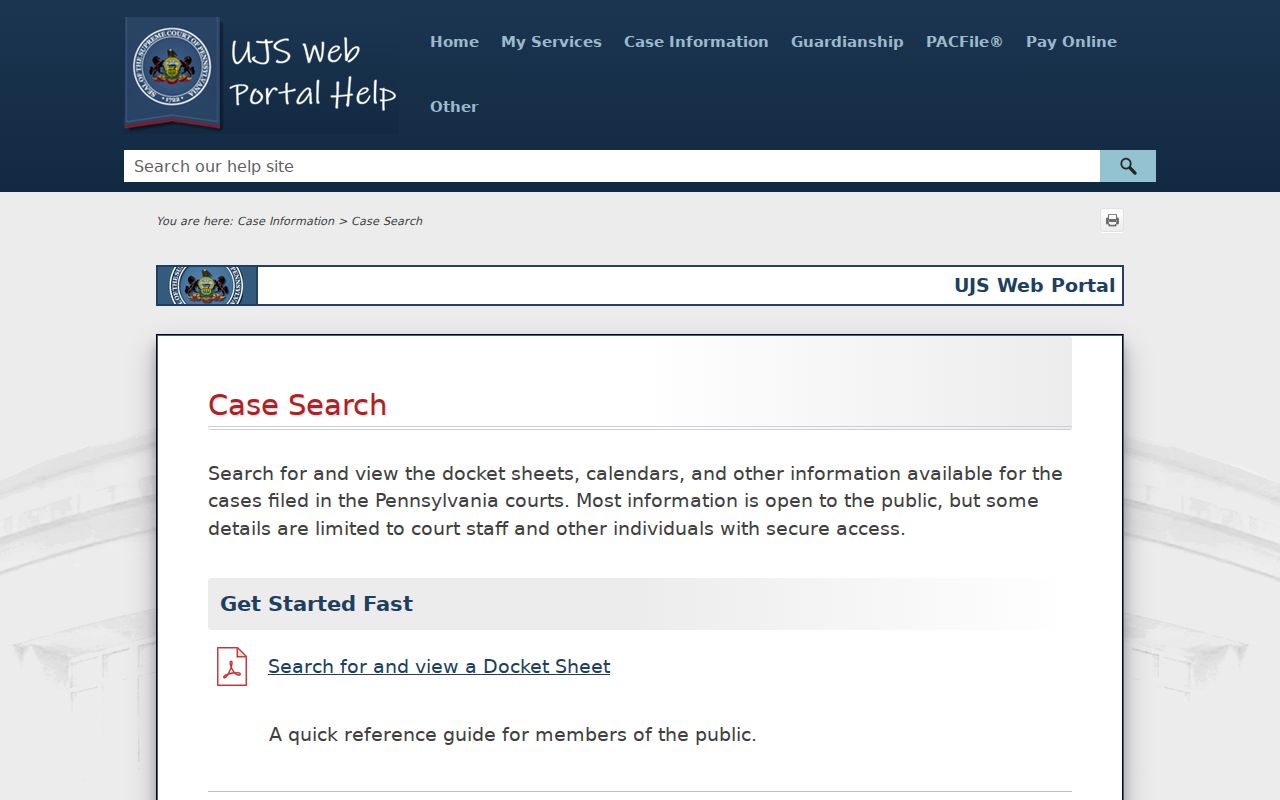
That portal view is the search layer for Allegheny County criminal cases; the DCR file remains the source when a pleading or certified copy is needed.
How to Search Case Records
Start with the court level that matches the case stage. Use an exact docket number when it is known. A name search can return unrelated people, so narrow the result with Allegheny County, criminal case category, filing dates, and date of birth only when that information is legitimately known. An OTN, the Offense Tracking Number tied to fingerprint processing, is also a stronger cross-reference than a shared name.
- Open Case Information in UJS Case Search and choose docket sheets rather than calendars.
- Select Common Pleas or the magisterial district and Pittsburgh Municipal level. Search both when the procedural stage is unclear.
- Enter the docket number, or use participant name with Allegheny County and other sound filters.
- Confirm the court, filing year, docket number, and status before reading each count and its disposition.
- Ask DCR for the official file when an essential pleading is absent or a certified record is required.
The portal provides several ways to narrow an Allegheny County criminal case search. Not every field appears in every court-level workflow.
| Field Label | Type | Required | Notes |
|---|---|---|---|
| Search target | Selector | Yes | Choose docket sheets or calendars |
| Court type | Selector | Yes | Common Pleas or magisterial district level |
| Case category and status | Dropdown | Contextual | Choose Criminal and narrow pending or disposed matters |
| Docket number and type | Text and dropdown | No | The most exact route when known |
| County and participant name | Dropdown and text | No | Use Allegheny and guard against common-name matches |
| Date of birth and filed dates | Date fields | No | Use only accurate, legitimately known details |
Allegheny County Files in Room 220
A web docket does not always include the document that answers the question. Room 220 of the Allegheny County Courthouse, 436 Grant Street, Pittsburgh, is the research point for criminal files from the current year and four prior years. Public computer terminals support on-site research. Older Allegheny County case files can still be requested, but staff must retrieve them from off-site storage and the current retrieval rate applies.
DCR divides services among counters. Room 114 handles docket service, appeals, bonds, summary appeals, and expungements. Room 220 handles criminal records, fines, costs, and restitution. Room 222 handles DUI matters. Staff at 412-350-5320 can explain procedure and file ordering, but they will not discuss case facts by telephone. A county criminal-record check costs $25, and certification costs $20 under the researched fee schedule. Personal checks are not accepted.
Department of Court Records
Allegheny County Courthouse
436 Grant Street, Room 220
Pittsburgh, PA 15219
Criminal records: 412-350-6075 or 412-350-5320
Weekdays, 8:30 a.m. to 4:30 p.m., except county holidays
Note: A printout from UJS is useful for review, but it should not be labeled a certified judgment.
What the Case File Shows
An Allegheny County criminal case file records the prosecution as it changes over time. Read each count separately. An original charge may be amended, withdrawn, dismissed, nolle prossed, merged for sentencing, or end in acquittal or conviction. The status line alone may not explain that history. Calendar events and filing entries show what occurred between the complaint and the final order, while sentence and financial sections answer different questions.
| Case Number & Court | The court level and local identifier, often CP-02-CR-sequence-year in Common Pleas |
|---|---|
| Charging Document | The complaint at the early stage and the district attorney's information in Common Pleas |
| Charges & Dispositions | Each count, statute, grade, and its own outcome |
| Docket Entries | Motions, orders, pleas, trials, continuances, warrants, and post-case filings |
| Hearing Dates | Past and scheduled calendar events at the relevant court level |
| Sentence & Financials | Custody or supervision terms, fines, costs, restitution, payments, and balances |
Reading Allegheny County Dispositions
Court terms can change the meaning of an Allegheny County docket. A disposition is the outcome of a charge. “Nolle prosequi” means the prosecution was discontinued with the court's permission. “Withdrawn” means a charge was removed, while “dismissed” means it ended without a conviction. An acquittal is a not-guilty result. A nolo contendere plea means no contest and is treated as a conviction, though it is not an admission phrased as a guilty plea.
- OTN
- The Offense Tracking Number links fingerprint and arrest reporting with the prosecution.
- Information
- The district attorney's Common Pleas charging document.
- ARD
- A pretrial diversion program whose events can appear on the docket.
- PCRA
- A post-conviction filing that can affect the later case history.
- Restitution
- Payment ordered for a loss, separate from fines and court costs.
The official PSP criminal-history service page also distinguishes a court file from a Pennsylvania repository check.
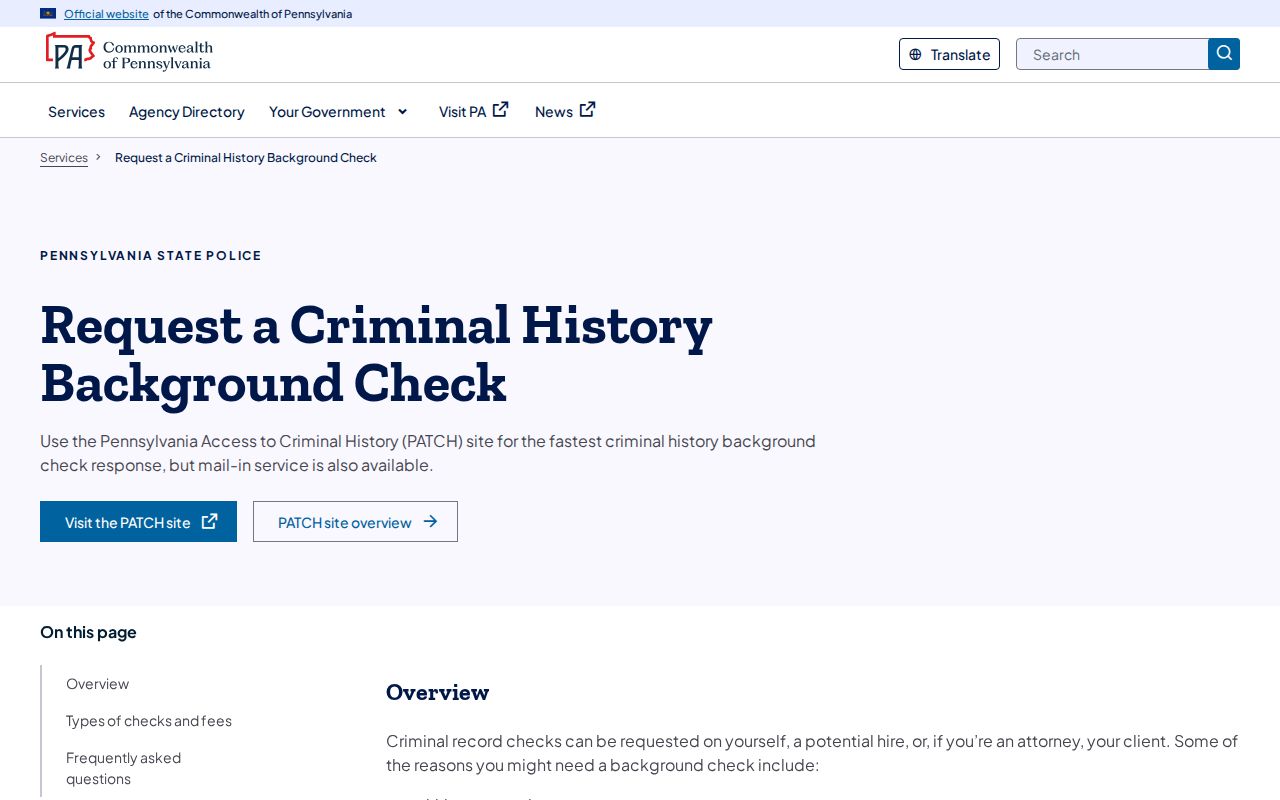
PATCH may summarize Pennsylvania criminal-history data, while the Allegheny County docket shows the prosecution's events and charge-level outcomes.
Stages of a Criminal Case
An Allegheny County criminal matter does not appear all at once. A complaint begins in Pittsburgh Municipal Court or a magisterial district court. Preliminary arraignment addresses the initial charge and bail. At the preliminary hearing, the lower court decides whether the Commonwealth has made the threshold showing needed to hold charges for Common Pleas. The district attorney may then file an information. Formal arraignment, pretrial motions, a plea or trial, disposition, and sentencing follow as the case requires.
Case flow: Charges Filed › Arraignment › Pretrial › Plea or Trial › Disposition › Sentencing
Later entries can include a post-sentence motion, appeal, PCRA petition, or probation and parole violation proceeding. These are part of the court history, not new proof that every original allegation resulted in guilt.
Allegheny County Specialty Court Dockets
Six named problem-solving courts add local context to Allegheny County criminal case records: Domestic Violence, DUI, Drug, Mental Health, Sex Offender, and Veterans Courts. The Fifth Judicial District problem-solving courts operate through the criminal division at 436 Grant Street, with a published contact number of 412-350-2322. Their docket entries may reflect treatment, review hearings, supervision, or program milestones.
A specialty docket does not erase the underlying case. It changes how the court may manage eligible participants and can add events that a reader must interpret in procedural context. The current Common Pleas judicial roster helps identify the assigned judicial office, while filing questions and copies still belong with DCR.
Access & Restrictions
Public electronic access has firm limits. Under the UJS Electronic Case Record Public Access Policy, Social Security numbers, operator-license numbers, and victim identity or contact data are excluded from public electronic case records. Juvenile files are confidential or restricted. Active investigations may be withheld or redacted, and a sealed warrant may remain unavailable while the court order controls.
Expungement and limited access have different effects. Expungement under Pennsylvania law removes qualifying criminal-history information subject to narrow exceptions. Limited access and Clean Slate relief restrict ordinary dissemination but preserve access for authorized courts and justice agencies. A missing UJS result therefore does not prove that no case event ever existed. Check spelling, aliases, court level, year, and county, then ask DCR about procedure if a record still cannot be found.
The Pennsylvania Right-to-Know Law governs many agency requests, but judicial case files follow court access policy and sealing orders rather than ordinary agency routing.
The official IDEMIA/IdentoGO clearance channel supplies a separate identity-based route when an authorized program calls for it.
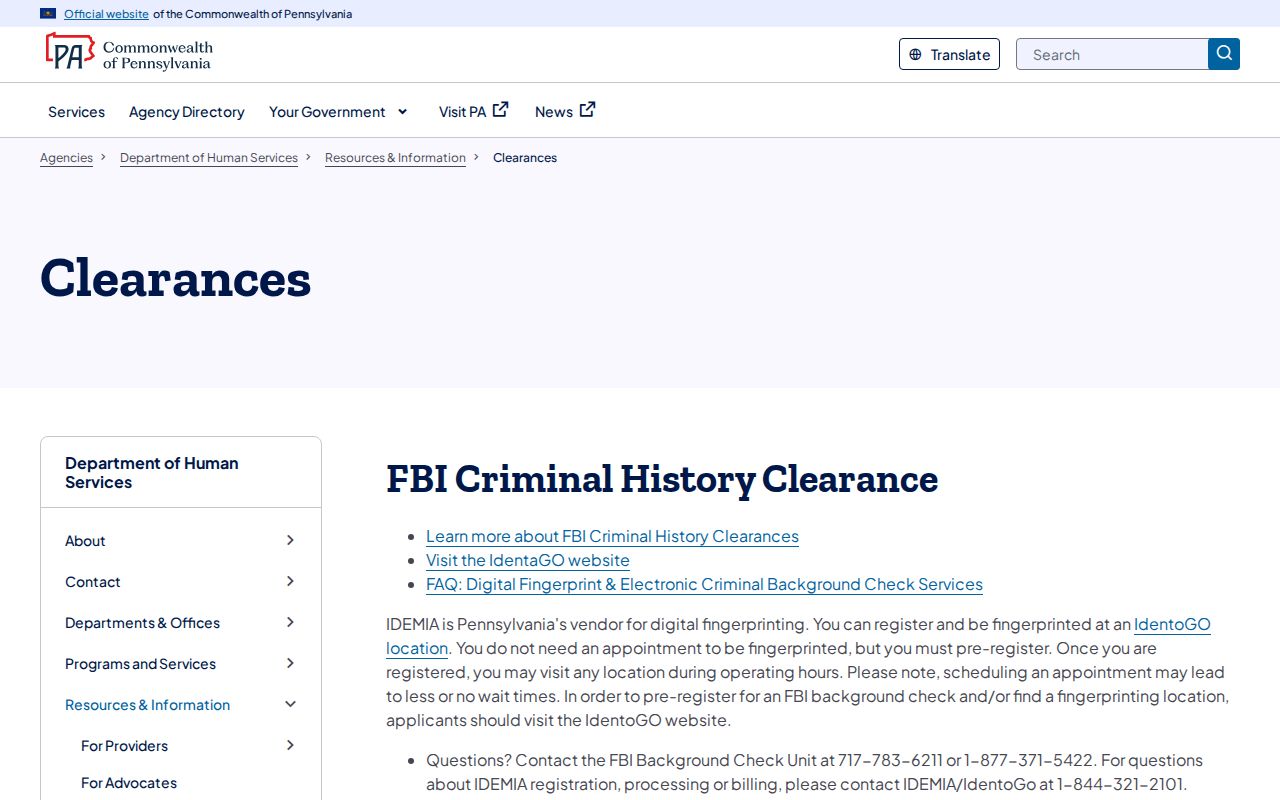
IDEMIA/IdentoGO requires pre-registration; it does not replace UJS or the Allegheny County court file for reading a prosecution.
Allegheny County Records Stay Separate
The court, PSP, jail, and registry answer different questions. The Pennsylvania State Police Megan's Law Public Website is a specialized statutory registry, not an Allegheny County criminal docket.
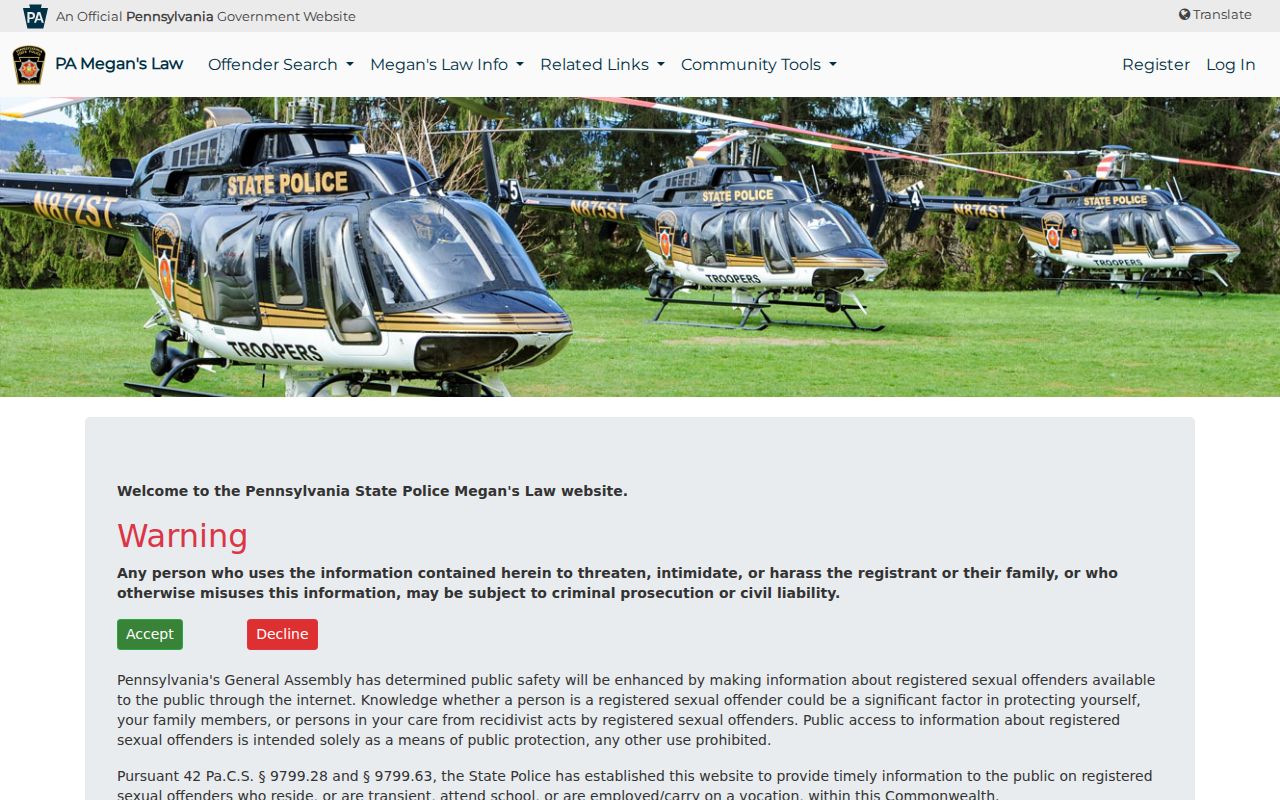
Use UJS and DCR for charges, pleas, motions, disposition, and sentence. Use PATCH for a repository response, the jail for current county custody, and the registry only for its defined registration purpose.